
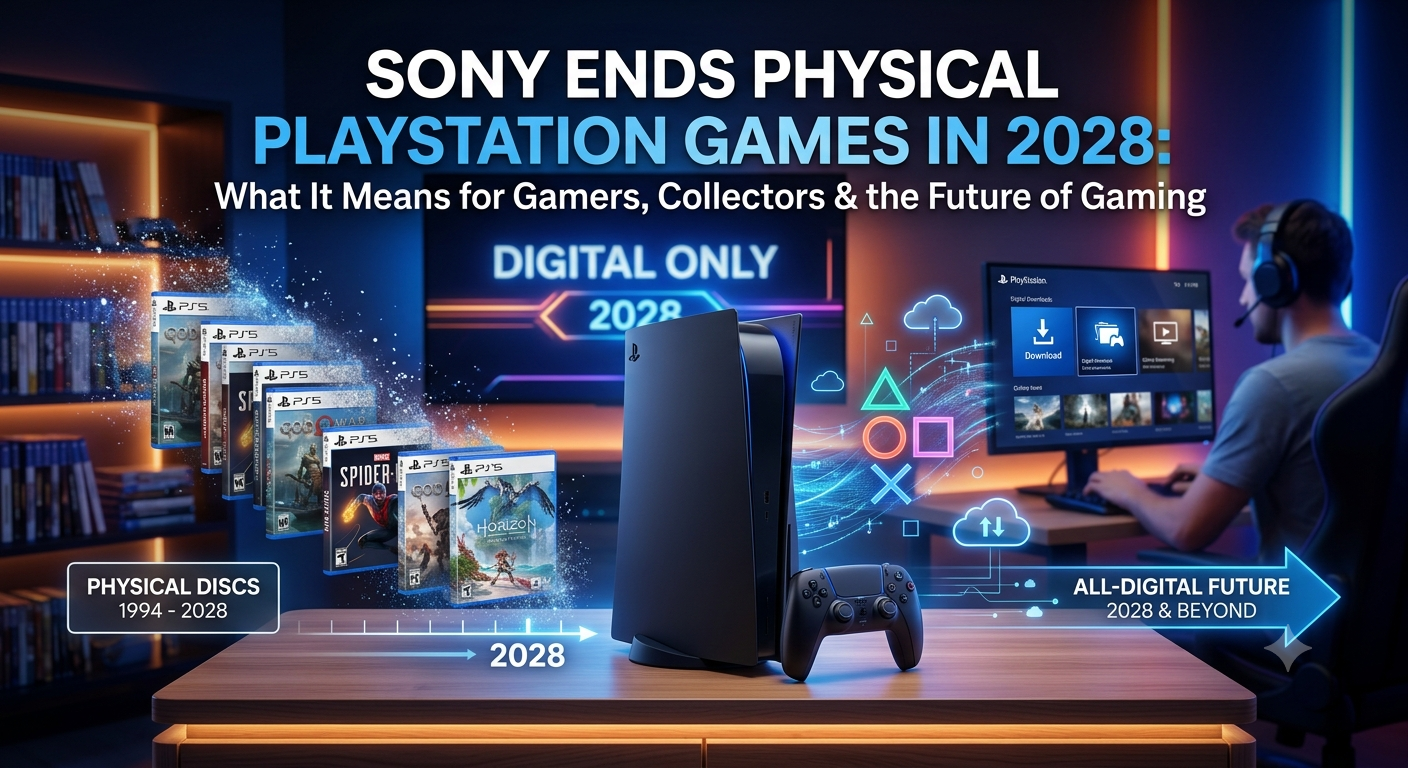
As consumer tastes and the broader entertainment industry continue to shift away from physical discs to digital, physical game disc production for all new games releasing on PlayStation consoles will be discontinued starting January 2028. Following this date, new games will be available on the PlayStation Store and at merchants in digital-only formats. This transition has no impact on games that have already been released or will be released in disc format before January 2028.
Sony Officially Ends Physical PlayStation Game Discs
This is a natural direction for Sony Interactive Entertainment to adapt to consumer trends as the general preference for digital media significantly outpaces physical discs.
This evolution will enable us to align more closely with how most of our community prefers to access and play games today.
We’ll continue to prioritize our resources to drive innovation in how players can access games and provide choices as to where players prefer to purchase new games, whether that’s at retailers or PlayStation Store.
We remain committed to delivering a world-class gaming experience to our fans, and we thank you for your continued support.
It definitely… has me kind of cautious. I’m watching to see what’s happening because…
I think it is going to spike the retro market, but it also could potentially push away people from collecting physical as much because now there’s no longer physical games to get,” he exemplified.
While he is unsure PlayStation would consider reversing course on the decision, Turnbow hopes the company will consider a compromise with gamers who don’t want to digitize their game library.
One potential solution could be limited releases of physical copies for games in high demand among collectors.
“I think that they should listen to people is the main thing. You know, listen to what the audience is saying, and kind of go from there,” he said.
According to PlayStation’s announcement, the change will have “no impact on games that have already been released, or will be released, before January 2028.”
Collectors Fear the End of Physical PlayStation Ownership
In the wake of Sony’s almost casual three-paragraph announcement that it would stop printing physical discs from January 2028, there has been a strong response from all corners of the gaming world.
More than 65,000 Digital Foundry viewers have voted against the decision in a YouTube poll, while a Change.org petition urging Sony to reconsider has attracted over 120,000 signatures.
The petition was started by Jade Pearce, CEO of a separate Canadian games retailer, and offers a good summary of the arguments against the change. That includes the impossibility of used game sales or game lending, lock-in to a single marketplace, and the knock-on effects on the many industries that rely on physical game discs. I’d also mention the difficulties for users on slow or capped internet connections as another good reason to oppose Sony’s plans.
Digital Foundry’s John Linneman previously went on record to speak against the decision, pointing to how digital game ownership is metamorphosing into game rental, ie temporary arrangements that can be rescinded at any time.
After all, Sony announced that the PS3 and PS Vita storefronts were being shuttered on the same day, while a week earlier purchases of more than 500 digital movies were removed by Sony from owners’ libraries without compensation, and the biggest game of the generation, Grand Theft Auto 6.
Physical PlayStation Games Will Be Digital-Only Beginning January 2028
While Sony no doubt expected backlash against their plans, it seems likely to be a business decision – where any lost revenue from players that switch to rival consoles or PC is made up for by higher income from digital games, which can’t be resold or purchased at a discount from rival platforms as physical games can.
This could be a vital component for Sony’s console strategy going forward, given the ongoing AI-driven price hikes to flash memory components like SSDs and RAM would make the PlayStation 6 much more expensive than prior generations.
Over time, his collection grew to include hundreds of games and several consoles. Fast forward to November 2025, Turnbow began selling retro games and consoles at Collector’s Realm, located in the Quincy Town Center.
Now, Turnbow said he’s worried that gamers are losing ownership of the products they pay for.
“When you get digital, yeah, it’s convenient, but a lot of times… you don’t actually own what you’re playing anymore.
So I know they could potentially just take it for different reasons or delete it for whatever reasons, which is kind of not cool because… you’re paying ‘X’ quantity of money and it just keeps getting more and more every year.
And at this point, they’re going to give you less and less,” he said.
Anxieties About Used Contests, Lending, and Consumer Choice
While Sony is currently in the headlines, a clear alternative for dissatisfied PlayStation users isn’t readily apparent. Nintendo is the major console manufacturer that has continued to embrace physical media – albeit with a new option for “game-key cards” for the Switch 2 generation that aren’t as useful for collectors – but a slightly narrower band of games is available for the Nintendo platform.
Meanwhile, Microsoft is likely to be considering a digital-only Project Helix console backed with a “Disc2Digital” feature, though allowing access to multiple PC game marketplaces would provide some flexibility for users to purchase digital games at discounted prices.
The Steam Machine is also an option for a console-like experience, though its price-to-performance ratio is significantly behind consoles and some distance behind similarly-sized custom PCs as well – and, of course, there’s no disc drive here either.
As the news about Sony’s decision to cease manufacturing physical games in January 2028 has started to sink in, I’ve been thinking about the wider implications of this.
Obviously the immediate concern has related to our own personal purchasing habits, the persistence of our libraries, and our overall consumer rights.
But one thing I can’t stop thinking about is the impact on retail and how PlayStation’s presence is likely to fade.
I’ve been travelling a lot the last few years, and one thing that’s really opened my mind is just how ubiquitous PlayStation is – especially in Asia.
Nintendo, Xbox, and PC Offer Distinguishable Directions Physical PlayStation
Our relationship with the high street is different in the US and the UK, so it’s not really the same, but I still think having a presence in stores is important.
Now, in the interest of fairness, I think it’s important to point out what Sony has actually said about this.
On the PS Blog, it wrote as part of its statement: “New games will be available on PS Store and at retailers in digital formats only.”
So it seems it’s going to have some kind of solution for the high street, presumably voucher codes. In other words, it’s not completely going away.
But obviously it’s going to change how people interact with retail, and I think it’s going to kill a lot of stores. That’s not Sony’s problem, I suppose, but it is worth acknowledging at least.