

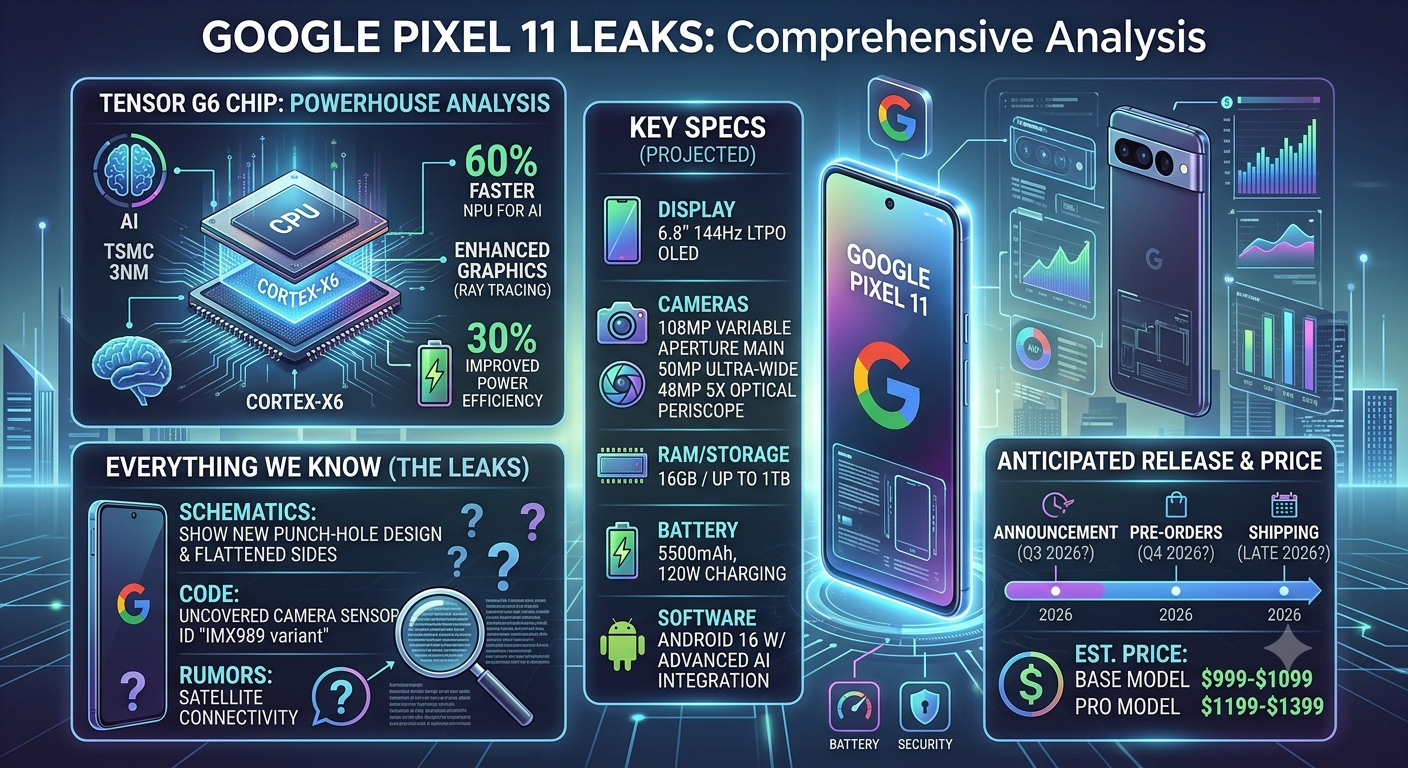
Google hasn’t confirmed a single Pixel 11 spec, but a May 2026 leak from Mystic Leaks just laid out nearly everything. The gap between the Google Pixel 11 and Pixel 10 is the widest since Google switched from Samsung to TSMC for fabrication last year, with a 2nm chip, new camera sensors, and a hardware feature borrowed from Nothing’s playbook. Here’s what’s actually changing, what’s risky, and whether it’s worth waiting.
The Tensor G5 inside the Pixel 10 was Google’s first chip built on TSMC’s 3 nm process—a big deal after years of sluggish Samsung-made silicon.
Google Pixel 11 Leak Reveals Major Upgrades
The Tensor G6 in the Pixel 11 pushes that to 2nm, making it one of the first smartphones to use TSMC’s most advanced fabrication node.
What does that mean in practice? TSMC’s published specs estimate around 15% better power efficiency at equivalent clock speeds. The G6 also moves to a 7-core CPU layout (1+4+2) using ARM’s newer C1 cores, compared to the G5’s 8-core design with Cortex-X4 and A725 cores.
Early Geekbench listings tied to the codename “Kodiak” suggest single-core performance around 2,354—a notable jump from the G5.
Google Pixel Tensor G6 Chip Brings Google’s First 2 nm Processor.
Google is expected to launch the Pixel 11 series sometime in late August. Specs and renders of the Pixel 11, Pixel 11 Pro, Pixel 11 Pro XL, and Pixel 11 Pro Fold have already leaked, so we already have a fair idea of what’s in store.
What we didn’t know was the price, especially given the AI-driven price increase. Now, a new leak is giving us a detailed picture of what the Pixel 11 series could cost, and it’s not looking great.
For the standard Pixel 11 and Pixel 11 Pro, this increase could effectively mean buyers might pay what the 256GB variants cost in previous generations, with the entry-level Pixel 11 potentially starting at €999 (~$1,140) and the Pro at €1,199 (~$1,370).
Google Pixel 11 Camera Upgrades
However, the premium Pixel 11 Pro XL and Pixel 11 Pro Fold could be facing straight price hikes, with the Pro XL allegedly starting at €1,399 (~$1,600) and the Fold pushing up to a steep €1,999 (~$2,285) for the 256GB base configurations.
It’s tempting to upgrade to the shiniest new object as soon as it’s released, especially when it comes to smartphones. But sometimes, it’s an iterative update that isn’t worth trading in for unless you’re moving up from a really old device.
Sometimes, the previous-generation model is powerful on its own and will meet your needs just fine, especially if you don’t plan to use every bell and whistle it offers. When you know a new model is coming soon, it might be enticing to wait.
Made by Google Pixel Event Expectations
But when it comes to the Google Pixel 11, which is almost certainly going to arrive in summer 2026, waiting might not yield much of a payoff.
This is the Google Pixel 10 Pro Fold, which is as dependable as any of Google’s products. Compared with its previous model—the Pixel 9 Pro Fold—the new model’s frame is fashioned out of higher-strength aluminum and has an upgraded steel hinge.
Dimension-wise, the Pixel 10 Pro Fold remains the same as its predecessor (155.2 x 76.3 x 10.8 mm when folded and 155.2 x 150.4 x 5.2 mm when unfolded), but, at least, the Pixel 10 Pro Fold’s inner and outer screen are brighter and have a certified IP68 rating for full dust and water protection.
For battery capacity, the Pixel 10 Pro Fold is now 5,015mAh and has Qi2 charging. The foldable has built-in magnets that allow for “Pixel Snap” accessories (do you mean “MagSafe” accessories, you ask?). Shhh.
You get seven years of Android OS updates and security patches, and the camera system still holds up, thanks to the three-camera setup (main, ultrawide with macro, and a 5x optical zoom telephoto) and Google’s AI-driven computational photography tools.
MediaTek M90 Modem for Better Connectivity in Google Pixel
Google still hasn’t announced its next-gen Pixel 11 phones, but we have every reason to believe that they’re coming in August.
The last two generations of the smartphone series were launched in August, coinciding with the annual Made by Google event. We expect the same this year, rather than going back to the October release window we saw in previous releases.
Google’s Pixel series has long faced connectivity complaints. However, Google seems to have addressed them by using MediaTek M90 modems, promising better connectivity.
It features a 6.3-inch OLED panel on the front with a 120Hz refresh rate and a dual-camera setup on the rear. The standard Pixel 11 will have a 5,000 mAh battery with a slight upgrade.
Google is expected to launch the Pixel 11 and the Pixel 11 Pro in August 2026 or September 2026, alongside the Pixel 11 Pro XL and the Pixel 11 Pro Fold. As far as the pricing is concerned,
Brighter Inner and Outer Displays Google Pixel
The standard Pixel 11 is said to be priced between Rs 79,990 and Rs 84,999. The Pro model is likely to start around Rs 103,999.
Google is expected to introduce its next-generation Pixel smartphone lineup in the coming months. The upcoming series will most likely include four models: the Pixel 11, Pixel 11 Pro, Pixel 11 Pro XL, and the Pixel 11 Pro Fold.
While Google has yet to officially reveal any details, several leaks and rumors have already provided a glimpse of what the Pixel 11 Pro Fold could offer.
Performance Expectations
From its expected launch timeline and potential pricing to its rumored specifications and features, here’s everything we know so far about Google’s next foldable flagship.
Google and Samsung have plenty of experience when it comes to foldables, and they’re both powered by some of the most popular flavors of Android available right now.
The question is, which new foldable is going to be the better purchase? We don’t know everything about the Z Fold 8 Ultra or Pixel 11 Pro Fold just yet, but there have been enough rumors and leaks to give us an idea of what to expect.
For More: Visit